One pec bigger than the other? Here's what to check
If one pec looks bigger than the other, a photo alone cannot tell you why—or whether that side is stronger. Start with comparable photos, then consider appearance, exercise performance and symptoms separately. Unilateral chest training can help you track each side's work, but it is not a guaranteed way to make your chest symmetrical.
What do you mean by “bigger”?
Describe what you have noticed as precisely as you can:
- Fullness or size: one side looks thicker, rounder or more prominent.
- Outline or position: one side has a different lower edge or appears to sit lower.
- Exercise performance: one arm completes fewer controlled repetitions, follows a different path or struggles to hold the same position.
Those observations can occur together, but one does not establish the others. A picture shows an outline under particular conditions; it does not measure pressing strength.
If you feel one pec more during a press, record that as a sensation. It is not, by itself, a measurement of muscle growth. A more useful training record includes the exercise, load, repetitions and how consistently you performed them.
How to compare your chest fairly
Before deciding that you have uneven pecs, give both sides the same chance to be seen.
- Keep the camera level and directly in front of you. Repeat its height, distance, lens and framing. A stable support and timer make this easier.
- Light both sides similarly. Avoid comparing a side-lit image with an evenly lit one. Keep the light source and its direction consistent between sessions.
- Repeat your torso and arm position. Face forward, without deliberately bringing one shoulder closer to the camera. Keep your arms in the same position.
- Compare the same pose. Relaxed photos belong with relaxed photos; flexed photos belong with the same flexed pose.
- Keep workout conditions comparable. Note whether you have just trained. Keep pumped and unpumped pictures in separate comparisons.
- Look across comparable images. Check whether the same difference remains, rather than deciding from one dramatic angle. Keep the originals without shape edits or extra contrast.
This is a practical way to make the comparison more consistent. It does not measure the true volume of either pec. Research on standardized torso photography describes a controlled capture protocol; an ordinary progress photo should not be treated as the same measurement method.
For the full setup and record-keeping method, use our guide to taking physique progress photos you can compare.
Make comparisons at planned progress check-ins. You do not need to keep retaking pictures throughout the day or inspect every pixel. The useful question is whether your records support a training decision.
Why one side of your chest can look different
Photo conditions and pose
Check these first because they are part of how the picture was made. Rotation changes the view of each side, while uneven lighting changes the shadows around its outline. Arm position and the choice to relax or flex also belong in your comparison notes.
If the difference looks much smaller with a square pose and even light, the setup contributed to the original impression. If it remains, that still does not establish its cause.
Muscle development and training
A difference in muscle development is one possible explanation, but a photograph cannot establish your training history or how much work each side has performed. Review your actual sessions: are both sides using a comparable movement range and technique? Does one side consistently lose position or complete fewer controlled repetitions?
Those observations can justify a technique or programming review. They do not prove that the larger-looking pec is stronger, or that your dominant hand explains the appearance.
Body structure and other tissue
The chest outline is not a direct tracing of the pec underneath it. Pectoral anatomy varies: a cadaver study of the pectoralis major documented differences in muscle structure. That establishes that variation exists; it does not identify your anatomy from a phone photo or tell you how common a particular outline is among lifters.
A persistent difference in shape or position therefore should not automatically become a target for extra sets. Do not assume that exercise can train away a structural difference.
If your question is whether fullness represents muscle, fat or something else, appearance alone cannot settle it. Our muscle-or-fat guide explains the limits of using photos and other progress records to judge tissue changes. A new lump or unusual change needs individual assessment.
Can unilateral chest exercises help?
Unilateral training means performing an exercise with one side at a time. A single-arm chest press lets you record the load, repetitions and control for each side separately. That can make a training review more informative when you have noticed a persistent performance difference.
Pressing two dumbbells at the same time is still a bilateral exercise: both arms are working together. Separate weights do not automatically make a movement unilateral. They also do not guarantee that uneven-looking pecs will become even.
One example: the single-arm cable chest press
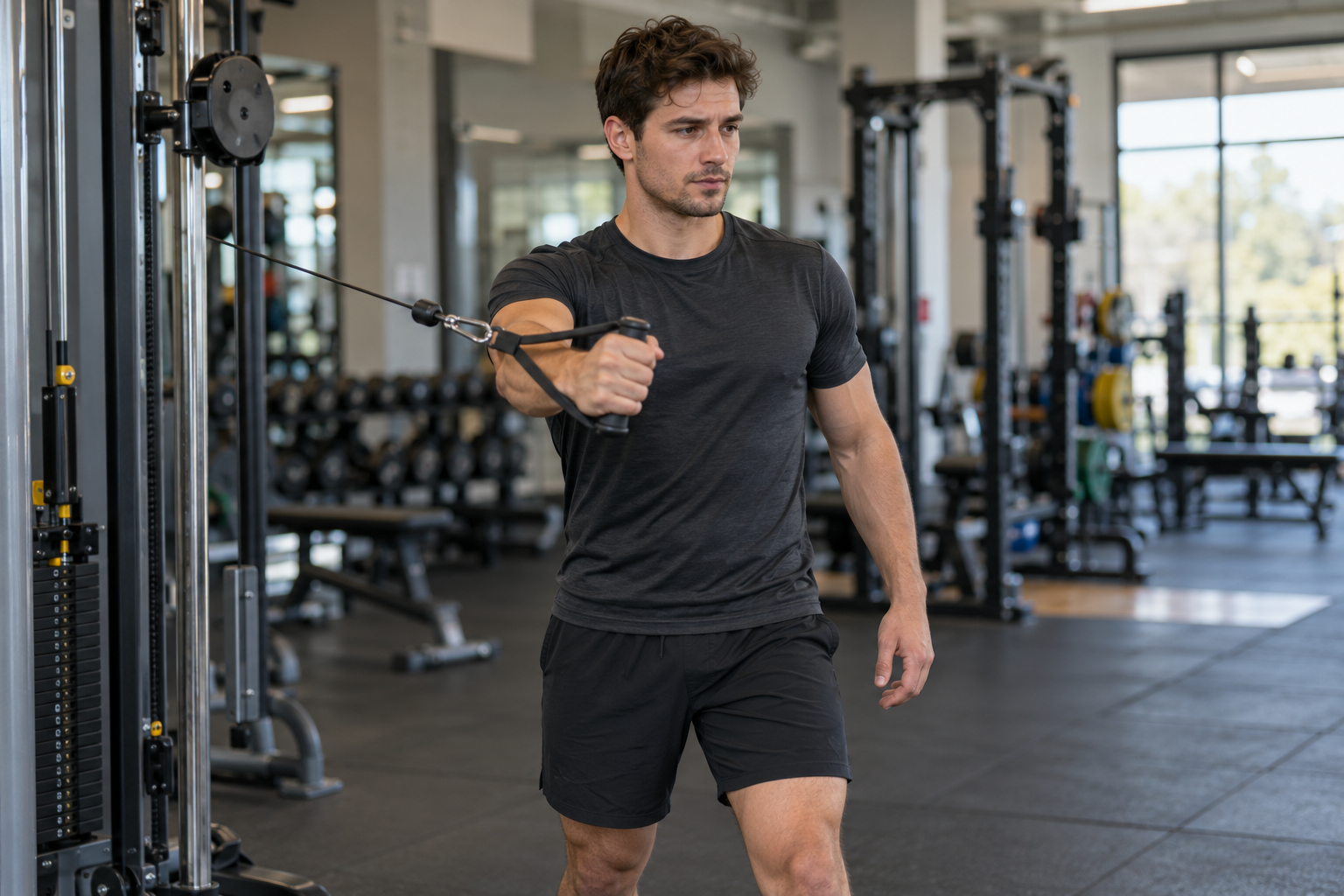
The American Council on Exercise describes a single-arm chest press with a cable or resistance band. For the cable version, its setup uses a single handle at shoulder height, with your back towards the machine and the working arm in line with the pulley. Keep your feet planted and trunk supported by a firm stance as you press forwards, then return the handle under control.
Choose resistance that lets you repeat the movement without using a torso twist to finish the press. If you are unfamiliar with the exercise, have a qualified coach help with the setup. Do not work through pain to complete the comparison.
The setup matters because a changed stance, starting position or movement range makes the two sides harder to compare. You are recording performance in a specific exercise, not isolating a diagnosis about one pec.
Make the exercise record useful
If you include unilateral pressing in your programme:
- Use the same equipment settings and a movement range you can control comfortably on both sides.
- Record each side's load, repetitions and any loss of position. Note arm order and rest so later sessions are comparable.
- Keep both sides trained. Ask a qualified coach to review a persistent difference in strength or control alongside your existing programme.
- Keep appearance and exercise progress in separate records. Better pressing performance does not establish that a visible size difference has changed.
A single photograph is not a reason to give the smaller-looking side extra sets. Nor does the appearance alone require you to abandon bilateral pressing.
What the research can—and cannot—tell you
A 2025 systematic review and meta-analysis found no statistically significant difference in muscle growth between unilateral and bilateral resistance training. It included nine studies, with limited literature and an overall moderate risk of bias. Strength improvements tended to favour the type of movement trained.
A 2026 review also found no statistically significant difference in muscle growth and rated the certainty of that finding as low.
These findings do not prove that the two methods produce exactly equal growth. They also do not establish that unilateral exercises correct visible pec asymmetry. Use one-arm work for a clear training purpose, such as tracking each side's performance, without attaching a promise of perfect symmetry.
What to do if the difference keeps showing
Choose your next step from the observation that persists:
- It mainly changes with the photo setup: improve the comparison conditions before interpreting it as a body change.
- It remains in comparable photos, with no symptoms or performance concern: the cause is still uncertain. If you want to review your training, bring those records to a qualified coach rather than choosing extra work from the picture alone.
- Strength or control also differs repeatedly: have a coach review the movement, equipment setup and programme. Pain or other symptoms need clinical assessment.
You do not need to make every visible difference a correction project. Focus on a useful goal and records that can help you judge it.
When to seek medical assessment
See a GP if you notice a new lump or swelling in your chest or armpit, changes to your chest or nipples that are unusual for you, or breast or armpit pain that does not go away. The NHS chest-check guidance recommends getting these changes assessed. They can have several causes; the symptom itself deserves attention. A physique grade cannot answer that concern.
What CutRank can add
If you want a broader visual read of your physique, CutRank offers an AI estimate of the muscle development visible in your submitted photo. Its grade and visible-muscle scores can provide another perspective alongside your own records. See how CutRank's photo-based physique rating works.
Treat that result as feedback on the image. It is not a verified measurement of the difference between your left and right pecs, an explanation of chest anatomy or a test of pressing strength. It cannot establish which side needs corrective training or assess a medical concern.
One angle free. Email required to reveal your result. No card required. Adults 18+ only. A visual AI estimate from your photo.